Sovereign‑grade commercial execution
Designed for multi‑party, multi‑cycle programmes

Deterministic execution for complex, sovereign‑scale programmes.

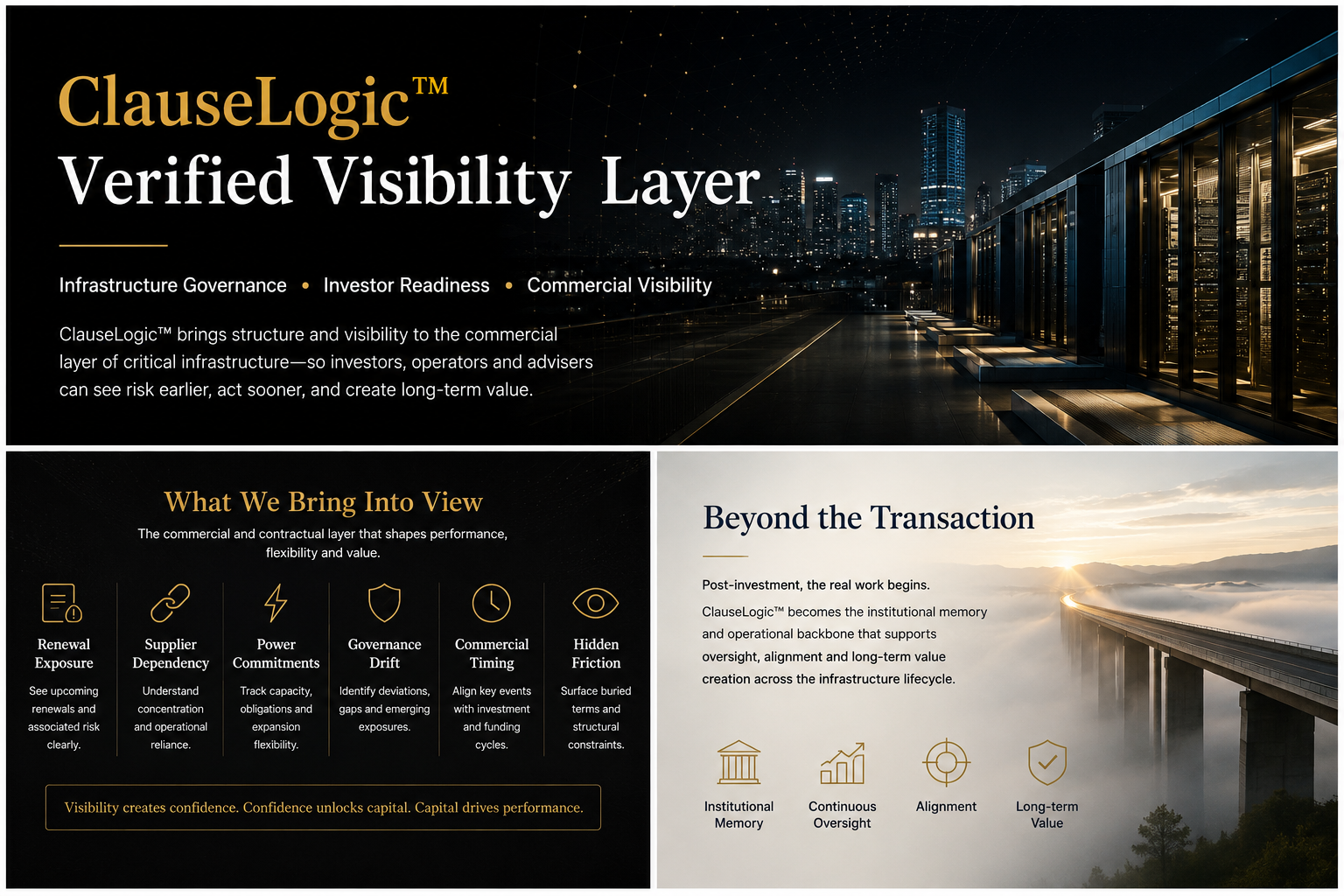
ClauseLogic™ is a sovereign execution architecture for commercial programmes where failure is not an option: hyperscale infrastructure, long‑horizon platforms, and multi‑party ecosystems that must perform under real‑world constraints.

Sovereign execution architecture

From contracts to an execution surface.

ClauseLogic™ reframes contracts, governance, and commercial operations as a single execution architecture: a structured surface where obligations, dependencies, and risk can be designed, instrumented, and iterated with precision.

Traditional contracting treats each agreement as a static artefact. ClauseLogic™ treats the entire commercial stack as an execution surface: a living system where clauses, controls, and commitments are composed into a coherent, observable architecture.

The architecture is designed for programmes where:

  • Multiple parties must coordinate over long horizons.
  • Execution risk is systemic, not isolated to a single contract.
  • Regulatory, technical, and commercial constraints interact in real time.

Instead of “managing contracts”, ClauseLogic™ defines and operates a sovereign execution surface: a structured, instrumented layer that sits between strategy, legal design, and operational reality.

Layer 1
Commercial intent & design
Strategic objectives, risk appetite, and value design expressed as executable commercial patterns rather than one‑off documents.
Layer 2
Clause & control architecture
A structured library of clauses, controls, and mechanisms that can be composed, versioned, and governed across programmes and counterparties.
Layer 3
Execution surface
The live surface where obligations, dependencies, and events are instrumented, monitored, and iterated under real‑world conditions.
Layer 4
Governance & observability
Sovereign‑grade governance, telemetry, and decision frameworks that allow operators to see, test, and adjust the commercial system in flight.
Architecture capsules

Composable units of sovereign execution.

Capsules are self‑contained architecture units: each one captures a specific execution pattern, risk posture, or governance mechanism that can be deployed across programmes without re‑inventing the stack.

Programme spine
Defines the core execution spine for a complex programme: how obligations, milestones, and dependencies are structured so that the entire system can be reasoned about, not just individual contracts.
Risk & control lattice
A lattice of controls, triggers, and mitigations that map directly to real‑world events, allowing operators to see how risk propagates and where interventions are most effective.
Counterparty field
Models counterparties as a dynamic field rather than static entities, capturing incentives, constraints, and interdependencies across the ecosystem so that execution remains stable under stress.
Governance runway
Establishes a forward‑looking governance runway: the decisions, forums, and escalation paths that must exist for the programme to remain executable over years, not quarters.
Sovereign execution surface

Where strategy, law, and operations converge.

The execution surface is where ClauseLogic™ is most visible: the live layer where strategy, legal design, and operational reality are reconciled into a single, observable system.

For sovereign‑scale and hyperscale operators, the cost of mis‑execution is measured in years, not weeks. ClauseLogic™ is designed for environments where the commercial system must remain coherent under regulatory change, technical evolution, and shifting counterparties.

Instead of treating each contract as a silo, the execution surface exposes how obligations, controls, and incentives interact across the entire programme. This allows operators to see where the system is fragile, where it is over‑controlled, and where value is being left on the table.

The result is a commercial architecture that can be explained, tested, and iterated with the same discipline applied to technical systems – but with the nuance required for sovereign‑grade programmes.